When you're shopping with a food allergy or intolerance, checking a food label can involve much more than a quick glance at the front of the packet.
Ingredients, emphasised allergens, precautionary statements and free-from claims can all provide important information and knowing where to look can make the process easier.
Here's a practical guide to reading food labels for allergens in the UK.
For most prepacked foods containing more than one ingredient, you'll find an ingredients list on the packaging.
Ingredients are generally listed in order of weight, starting with the ingredient used in the greatest amount.
In the UK, if any of the 14 regulated allergens are used as ingredients, they must be emphasised within the ingredients list. This could be through bold text, a different font, style or background colour.
For example, you might see:
Ingredients: Wheat flour (WHEAT), sugar, butter (MILK), EGG, cocoa powder...
The emphasis can make regulated allergens easier to spot, but don't stop reading there.
UK food businesses are required to provide information about 14 regulated allergens when they're used as ingredients.
These include milk, eggs, peanuts and sesame, alongside groups such as nuts and cereals containing gluten.
Rather than listing all 14 again here, we've created a separate guide explaining each one:
Read: What Are the 14 Major Allergens in the UK? →
Bold text is useful, but your dietary needs may extend beyond the 14 regulated allergens.
People can be allergic or react to foods that aren't included within the regulated 14, while others may need to avoid particular ingredients for different dietary reasons.
If this applies to you, checking only the bold words may not give you all the information you need.
Read the full ingredients list and look for the specific ingredients relevant to your own dietary requirements. Use the Freeater shopping feature to support you, to ensure you don't miss any important information.
You may also see statements such as:
“May contain milk.” or “Not suitable for people with a nut allergy.”
This is known as precautionary allergen labelling (PAL).
It is used to communicate a potential risk of unintended allergen cross-contamination, rather than telling you that the allergen has deliberately been used as an ingredient. Government guidance says PAL should be used where a potential cross-contamination risk has been identified that cannot be controlled.
You might also see products marketed as “free from” or “allergen-free”.
UK Government consumer guidance states that these claims are a guarantee that the specified allergen is not present in the product, and businesses making these claims must follow strict processes to prevent cross-contamination.
The important word here is specified.
For example, a product being labelled “gluten-free” doesn't automatically tell you whether it's suitable for every other dietary requirement you may have.
Continue checking the information that's relevant to you.
A vegan label and an allergen-free claim mean different things.
Government guidance specifically notes that vegan labelling does not guarantee that a food is free from a particular allergen.
If you're avoiding an ingredient because of an allergy, continue checking the allergen and ingredients information rather than relying solely on a vegan label.
It can be tempting to think:
“I've bought this before, so I already know what's in it.”
Building a habit of checking the product and packaging you're actually buying gives you the opportunity to spot the information that's relevant to you each time. Give it a quick scan to make sure you don't skip over a change.
This is particularly useful when you're shopping quickly, buying a different size or variety, or picking up something that looks very similar to your usual product.
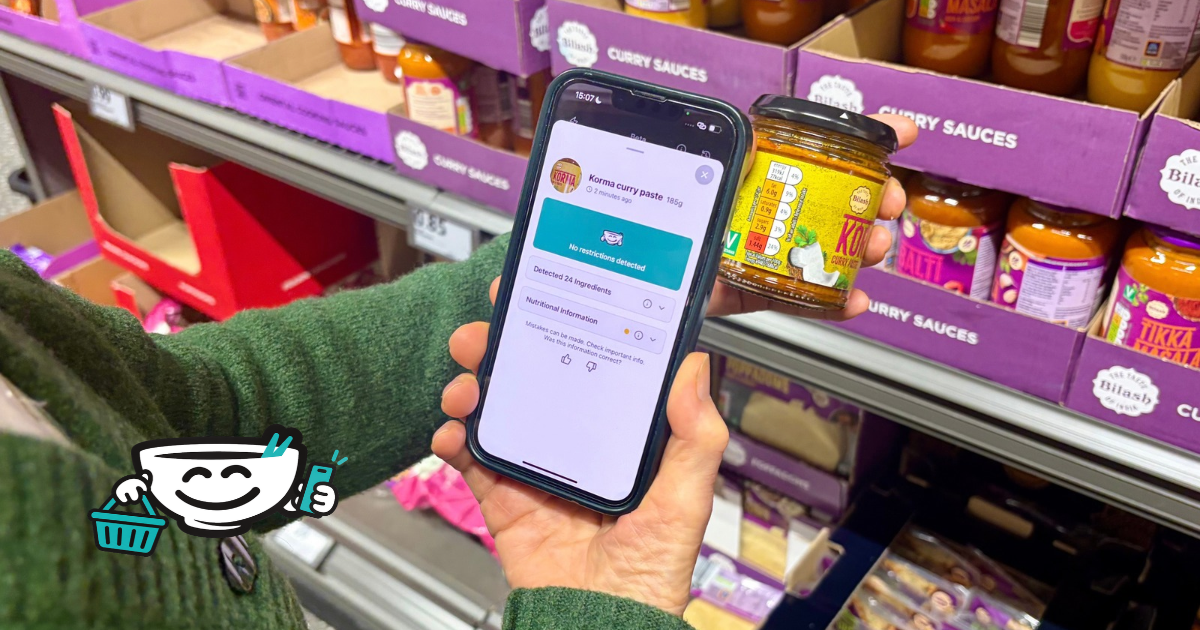
You may come across prepacked for direct sale (PPDS) food - for example, a sandwich packaged by a café before you choose it.
PPDS food must display the name of the food and a full ingredients list, with any of the 14 regulated allergens present emphasised within that list.
Even when you know what you're looking for, reading every ingredient on every product can take time.
Freeater Shopping is designed to provide an additional helping hand alongside your own checks.
Scan a product's barcode and Freeater can check the available product information against your personalised dietary profile, helping you identify information relevant to your dietary needs.
You can also access:
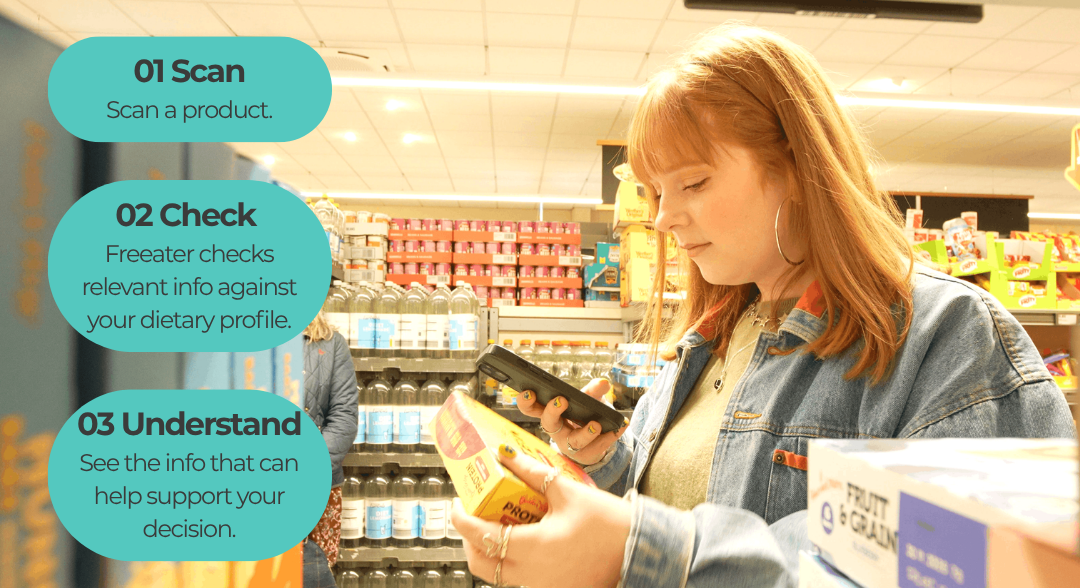
Freeater Shopping is designed to support your decision-making, not replace your own checks.
Always check the product packaging and ingredients yourself before consumption, including when Freeater returns a suitable result.
Food labels contain important information. Freeater is there to help make navigating it a little easier.
Scan smart. Stress less. 💚

Join the Freeater community